Explain How Your Family Background Has Influenced the Way You See the World
How East and West call back in profoundly different ways
(Image credit:
Getty Images
)

Psychologists are uncovering the surprising influence of geography on our reasoning, behaviour, and sense of self.
A
As Horace Capron start travelled through Hokkaido in 1871, he searched for a sign of human life amongst the vast prairies, wooded glades and threatening blackness mountains. "The stillness of death reigned over this magnificent scene," he later wrote. "Not a leafage was stirred, non the chirping of a bird or a living thing." It was, he thought, a timeless place, direct out of pre-history.
"How astonishing it is that this rich and beautiful country, the property of one of the oldest and most densely populated nations of the world… should have remained so long unoccupied and nearly every bit unknown as the African deserts," he added.
This was Japan's frontier – its own version of the American 'Wild W'. The northernmost of Nihon'due south islands, Hokkaido was remote, with a stormy ocean separating it from Honshu. Travellers daring to brand the crossing would accept then had to endure the notoriously brutal winters, rugged volcanic landscape and savage wildlife. And so the Japanese government had largely left it to the ethnic Ainu people, who survived through hunting and fishing.
All that would alter in the mid-19th Century. Fearing Russian invasion, the Japanese regime decided to reclaim the country'due south northland, recruiting sometime Samurai to settle Hokkaido. Presently others followed suit, with farms, ports, roads, and railways sprouting upwardly across the island. American agriculturists like Capron had been roped in to suggest the new settlers on the best means to farm the land, and inside lxx years the population blossomed from a few one thousand to more two million. By the new millennium, it numbered well-nigh half-dozen million.
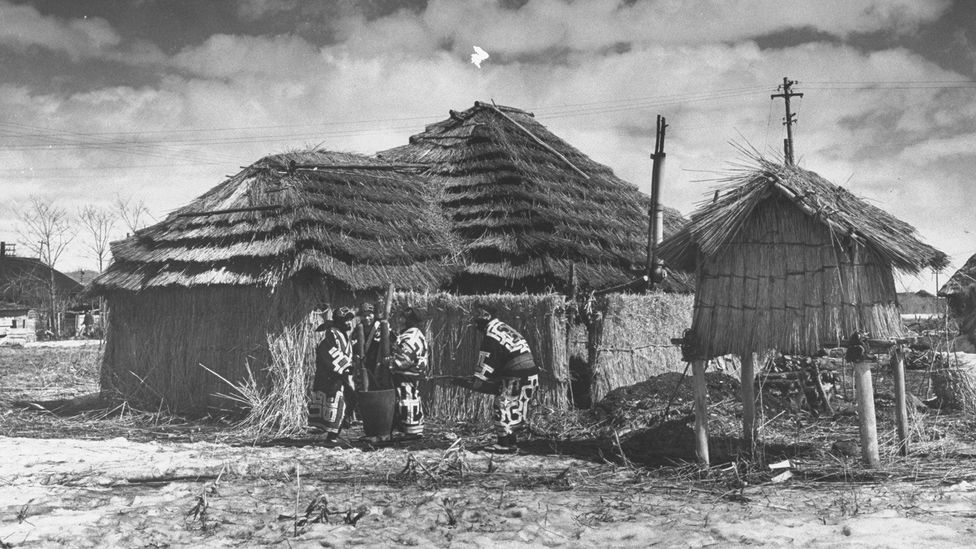
Before Emperor Meiji decided to populate the isle, the merely people to live in Hokkaido were the indigenous Ainu (Credit: Getty Images)
Few people living in Hokkaido today have ever needed to conquer the wilderness themselves. And yet psychologists are finding that the frontier spirit nevertheless touches the manner they recall, feel and reason, compared with people living in Honshu just 54km (33 miles) away. They are more individualistic, prouder of success, more than ambitious for personal growth, and less connected to the people effectually them. In fact, when comparing countries, this 'cognitive contour' is closer to America than the rest of Japan.
Hokkaido's story is just one of a growing number of example studies exploring how our social environment moulds our minds. From the broad differences betwixt East and West, to subtle variation between US states, information technology is becoming increasingly clear that history, geography and culture can change how we all call up in subtle and surprising means – right down to our visual perception. Our thinking may have even been shaped past the kinds of crops our ancestors used to farm, and a single river may mark the boundaries between ii unlike cognitive styles.
Wherever we live, a greater sensation of these forces can help us all empathise our ain minds a fiddling better.
'Weird' minds
Until recently, scientists had largely ignored the global diversity of thinking. In 2010, an influential article in the journal Behavioral and Brain Sciences reported that the vast majority of psychological subjects had been "western, educated, industrialised, rich and democratic", or 'Weird' for brusk. Near 70% were American, and most were undergraduate students hoping to gain pocket money or class credits by giving up their time to take role in these experiments.
The tacit assumption had been that this select group of people could represent universal truths about man nature – that all people are basically the same. If that were true, the Western bias would accept been unimportant. All the same the small number of bachelor studies which had examined people from other cultures would suggest that this is far from the case. "Westerners – and specifically Americans – were coming out at the far end of the distributions," says Joseph Henrich at the University of British Columbia, who was 1 of the study's authors.
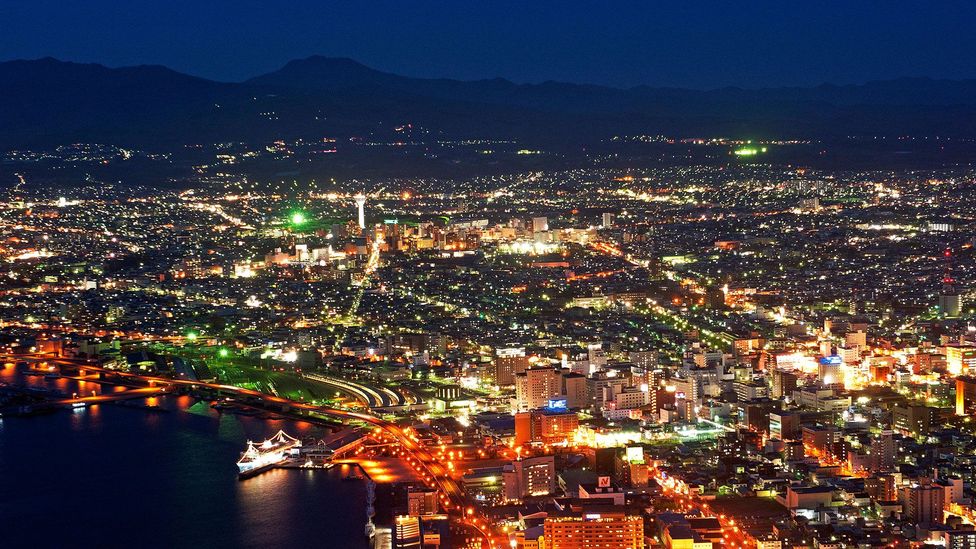
Hokkaido's population speedily grew from only a few 1000 to the vi million people who live at that place today (Credit: Alamy)
Some of the nearly notable differences revolved effectually the concepts of "individualism" and "collectivism"; whether yous consider yourself to be independent and self-contained, or entwined and interconnected with the other people around you, valuing the group over the individual. Generally speaking - at that place are many exceptions - people in the West tend to be more individualist, and people from Asian countries similar India, Nippon or Prc tend to exist more collectivist.
In many cases, the consequences are broadly equally y'all would expect. When questioned virtually their attitudes and behaviours, people in more than individualistic, Western societies tend to value personal success over group achievement, which in turn is likewise associated with the need for greater self-esteem and the pursuit of personal happiness. Just this thirst for self-validation besides manifests in overconfidence, with many experiments showing that Weird participants are likely to overestimate their abilities. When asked about their competence, for case, 94% of American professors claimed they were "better than average".
This tendency for self-aggrandizement appears to be about completely absent in a range of studies across Eastern asia; in fact, in some cases the participants were more likely to underestimate their abilities than to inflate their sense of cocky-worth. People living in individualistic societies may likewise put more accent on personal choice and freedom.
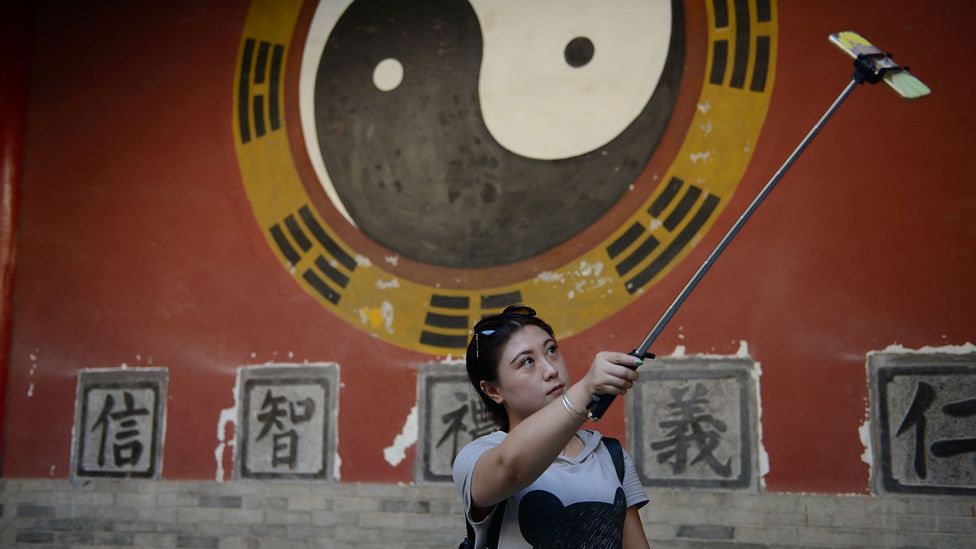
Holistic thinking permeates Eastern philosophy and civilisation (Credit: Getty Images)
Crucially, our "social orientation" appears to spill over into more cardinal aspects of reasoning. People in more collectivist societies tend to be more than 'holistic' in the way they think nigh bug, focusing more on the relationships and the context of the situation at hand, while people in individualistic societies tend to focus on dissever elements, and to consider situations as fixed and unchanging.
As a simple example, imagine that you run across a flick of someone tall intimidating someone smaller. Without whatever additional information, Westerners are more probable to call up this behaviour reflects something essential and stock-still about the big homo: he is probably a nasty person. "Whereas if you are thinking holistically, you would think other things might exist going on between those people: maybe the big guy is the dominate or the father," explains Henrich.
Welcome to The Human Planet
Humans are unique in their power to arrange to their environments - allowing us to build lives from the North Pole to the Sahara Desert. This article is the outset part of The Homo Planet, a new series in which BBC Future uses cutting-edge scientific discipline to explore our boggling diverseness.
And this thinking style also extends to the mode nosotros categorise inanimate objects. Suppose yous are asked to proper noun the two related items in a listing of words such as "train, motorbus, track". What would you say? This is known as the "triad test", and people in the West might pick "bus" and "train" because they are both types of vehicles. A holistic thinker, in contrast, would say "train" and "track", since they are focusing on the functional relationship betwixt the two – one item is essential for the other's job.
Information technology can even modify the style that yous see. An eye-tracking study past Richard Nisbett at the Academy of Michigan found that participants from East Asia tend to spend more than time looking effectually the groundwork of an image – working out the context – whereas people in America tended to spend more fourth dimension concentrating on the main focus of the picture. Intriguingly, this stardom could also exist seen in children's drawings from Japan and Canada, suggesting that the different means of seeing emerge at a very young historic period. And by guiding our attention, this narrow or diverse focus direct determines what we remember of a scene at a afterwards date.
"If nosotros are what we run across, and nosotros are attending to different stuff, and then we are living in different worlds," says Henrich.

In that location are no sharp divides between 2 culture'south different ways of thinking, and people in immigrant communities may incorporate both mindsets (Credit: Getty images)
Although some people have claimed that our social orientation may have a genetic chemical element, the show to engagement suggests that it is learned from others. Alex Mesoudi at the University of Exeter recently profiled the thinking styles of British Bangladeshi families in East London. He found that within ane generation, the children of immigrants had started to adopt some elements of the more individualistic outlook, and less holistic cognitive styles. Media use, in detail, tended to be the biggest predictor of the shift. "It tended to be more important than schooling in explaining that shift."
But why did the different thinking styles sally in the outset place? The obvious explanation would be that they only reverberate the prevailing philosophies that accept come to prominence in each region over time. Nisbett points out that Western philosophers emphasised freedom and independence, whereas Eastern traditions like Taoism tended to focus on concepts of unity. Confucius, for instance, emphasised the "obligations that obtained between emperor and subject, parent and child, husband and wife, older brother and younger brother, and betwixt friend and friend". These diverse ways of viewing the world are embedded in the culture's literature, pedagogy, and political institutions, and then information technology is possibly of lilliputian surprise that those ideas accept been internalised, influencing some very basic psychological processes.
Withal, the subtle variation between individual countries suggests that many other surprising factors are as well at work.
On the front line
Consider the USA, the most individualistic of all Western countries. Historians such as Frederick Jackson Turner have long argued that the expansion and exploration into the west has nurtured a more independent spirit, as each pioneer battled the wilderness and each other for their own survival. In line with this theory, recent psychological studies take shown that the states at the border of the frontier (such as Montana) tend to score higher on measures of individualism. To confirm the "voluntary settlement theory", however, psychologists would want to examine a second, independent, case study as a counterpoint.
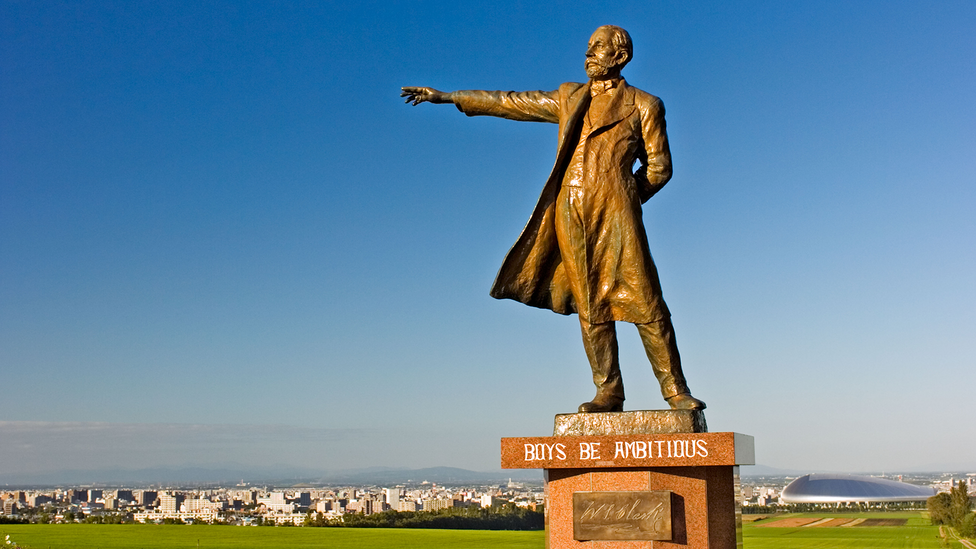
American agriculturists such as William S Clark helped tame Hokkaido. His motto - "Boys, be ambitious" - exemplifies the pioneer mindset that lingers to this mean solar day (Credit: Alamy)
It is for this reason that Hokkaido proves to exist and then fascinating. Like most Eastward Asian countries, Japan every bit a whole tends to accept a more collectivist and holistic mind-set. All the same the rapid migration to its northern territory resembles the rush to settle America'south 'Wild West'; the Emperor Meiji'southward regime fifty-fifty employed agriculturists from the US, like Horace Capron, to help cultivate the country. If the voluntary settlement theory is correct, those pioneers should have cultivated a more independent outlook in Hokkaido compared to the rest of the land.
Sure plenty, Shinobu Kitayama at the University of Michigan has found that people in Hokkaido tend to place a higher value on independence and personal achievement – and emotions such equally pride – than Japanese people from other islands, and they were less concerned about the views of others. The participants were likewise asked to take a social reasoning test, which asked them to discuss a baseball player using performance-enhancing drugs. Whereas Japanese people from other islands were more likely to explore the context – such equally the pressure to succeed – the Hokkaido Japanese were more likely to blame the player's personality or a flaw in his moral character. Once again, this trend to blame personal attributes is characteristic of an individualistic society, and much closer to the average Americans' responses.
Germ theory
Some other (counterintuitive) idea is that the contrasting mind-sets are an evolved response to germs. In 2008, Corey Fincher (now at the Academy of Warwick) and colleagues analysed global epidemiological data to bear witness a region'due south score of individualism and collectivism announced to correlate with disease prevalence: the more than likely you are to go infection, the more than collectivist yous are, and the less individualistic. The crude idea is that collectivism, characterised by greater conformity and deference to others, may make people more conscientious about fugitive the behaviours that could spread disease. It has been hard to prove that the apparent correlations in the real world are not acquired by some other gene, such as the relative wealth of the country, but lab experiments offering some support for the thought – when psychologists prime people to feel afraid of disease, they exercise seem to prefer more collectivist ways of thinking, such equally greater conformity to group behaviours.
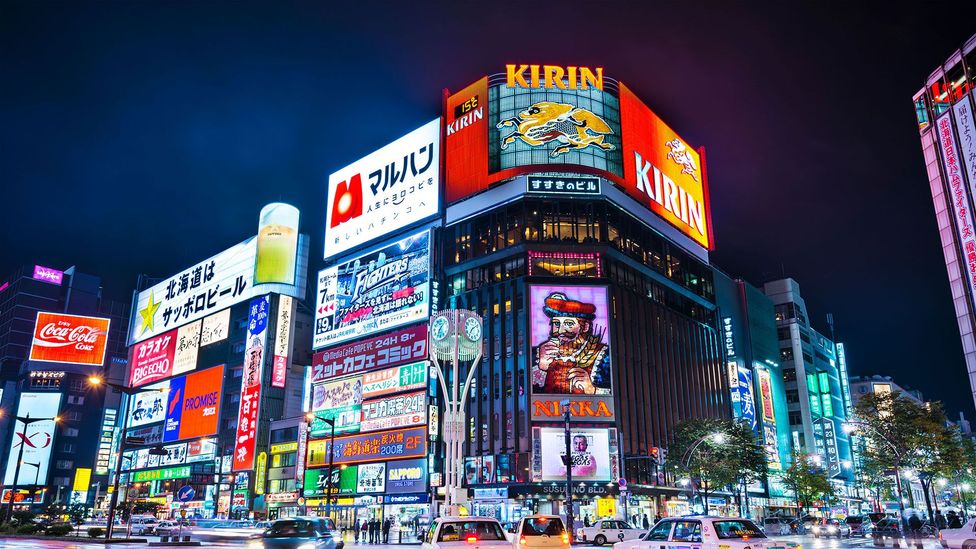
Hokkaido is no longer a frontier, only its history has left its inhabitants with some unique traits (Credit: Alamy)
But mayhap the well-nigh surprising theory comes from the farmyard. Thomas Talhelm at the University of Chicago recently examined 28 different provinces of China, finding that the thinking orientation appeared to reflect the local agriculture of the region.
Talhelm said he was showtime inspired by his own experiences in the country. While visiting Beijing in the north, he found that strangers would be much more forthcoming – "If I was eating alone people would come up and talk to me" – whereas those in the southern city of Guangzhou tended to be more reticent and fearful of offending.
This deference to others seemed like a subtle sign of a more collectivist mindset, and so Talhelm began to wonder what might prevarication behind the two outlooks. The divide did not seem to correlate with measures of wealth or modernisation, but he noticed that ane difference could be the kind of staple crop grown in the region: rice in nearly southern areas, and wheat in the n. "It splits almost neatly along the Yangtze River," says Talhelm.
Growing rice requires far greater cooperation: it is labour-intensive and requires complex irrigation systems spanning many different farms. Wheat farming, by dissimilarity, takes near half the corporeality of piece of work and depends on rainfall rather than irrigation, pregnant that farmers don't need to collaborate with their neighbours and tin focus on tending their ain crops.
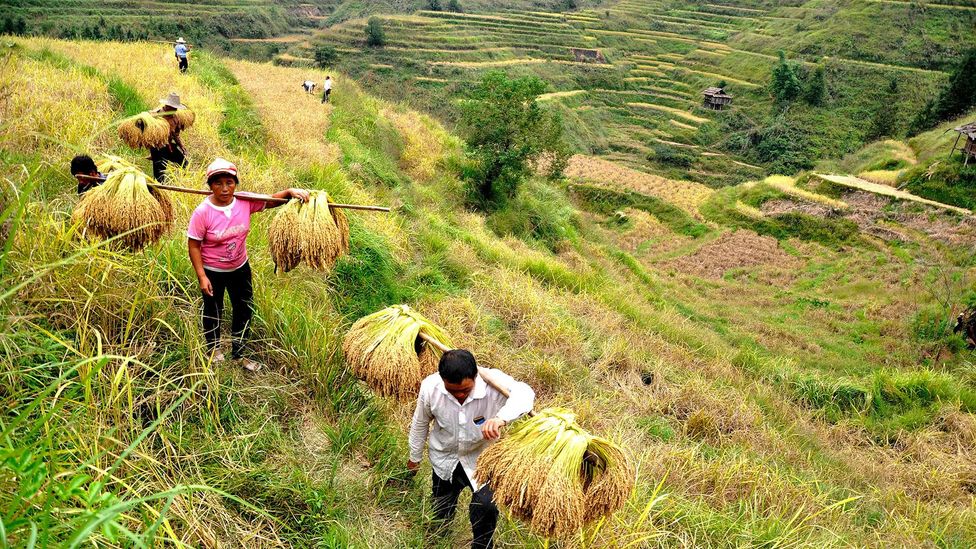
Compared to other kinds of agriculture, rice farming demands greater cooperation within a customs, with intricate irrigation systems spanning many plots (Credit: Getty Images)
Could these differences translate to a more collectivist or individualistic mindset? Working with scientists in Communist china, Talhelm tested more than one,000 students in various rice- and wheat-growing regions, using measures such every bit the triad exam of holistic thinking. They too asked people to draw a diagram demonstrating their relationships to their friends and associates: people in individualistic societies tend to draw themselves as bigger than their friends, whereas collectivists tend to make everyone the aforementioned size. "Americans tend to describe themselves very large," Talhelm says.
Sure enough, people in the wheat-growing regions tended to score higher on the measures of individualism, while the people in the rice-growing regions tended to testify a more collectivist and holistic thinking. This was true even at the borders between unlike regions. "Here are people in nearby counties, but one farms rice i farms wheat – and nosotros still found cultural differences."
He has since tested his hypothesis in India, which also shows a articulate carve up in wheat and rice growing regions, with like results. Almost all the people he questioned are non directly involved in farming, of grade – simply the historical traditions of their regions are still shaping their thinking. "There's some inertia in the culture."
Cognitive kaleidoscope
It'southward important to emphasise that these are just broad trends across vast numbers of people; there volition have been a spectrum within each population studied. "The idea that it'southward black and white – from an anthropological perspective that doesn't work," says Delwar Hussain, an anthropologist at the University of Edinburgh, who worked with Mesoudi on the study of London's British Bangladeshi customs. Every bit Hussain points out, there are many celebrated connections betwixt Eastern and Western countries that will hateful that some people straddle both ways of thinking, and factors like age and form will also take an effect.
Information technology is at present seven years since Henrich published his newspaper outlining the 'Weird' bias, and the response has been positive. He is particularly pleased that researchers like Talhelm are get-go to fix upwardly big projects to effort to understand the kaleidoscope of different ways of thinking. "Yous want a theory that explains why different populations have different psychologies."
But despite the good intentions, further progress has been slow. Cheers to the time and money it takes to probe minds across the earth, nigh inquiry nonetheless examines Weird participants at the expense of greater diversity. "We concord on the illness. The question is what the solution should be."
--
David Robson is BBC Futurity'southward characteristic author. He is @d_a_robson on Twitter .
Join 800,000+ Hereafter fans by liking u.s.a. on Facebook , or follow united states of america on Twitter , Google+ , LinkedIn and Instagram .
If you liked this story, sign up for the weekly bbc.com features newsletter , chosen "If You Only Read half-dozen Things This Calendar week". A handpicked selection of stories from BBC Future, Earth, Culture, Capital, Travel and Autos, delivered to your inbox every Friday.
Source: https://www.bbc.com/future/article/20170118-how-east-and-west-think-in-profoundly-different-ways
0 Response to "Explain How Your Family Background Has Influenced the Way You See the World"
Post a Comment